Home / Research examples / Waiting three days after a large drop
Did waiting three days after a large drop help?
Plenty of traders say you should let a falling stock settle before buying. This test compares buying at the close of the drop against buying three trading days later.
The company says so in its own docs. The source is linked and dated.
I ran it and this is what happened. Inputs and steps are shown.
My judgment. You may weigh the same facts differently.
The test
- Question
- After a stock falls sharply in one day, compare buying at that close against buying three trading days later.
- Inputs
- Event: an S&P 500 stock closes down 10% or more in one day, using membership as of the event date. Entries: that close, or the close three trading days later. Holding period: 20 trading days from each entry. Events from January 1, 2020 through December 31, 2025.
- Method
- Give each platform the same event definition once, in plain English, through its AI assistant.
- Measure the return of both entry rules over the same 20-day holding period.
- Record the number of events found and the average and median return of each entry.
- Result
- Observed
NexusTrade QuantConnect Composer Tested without writing code Yes Yes, the assistant wrote the Python Yes Question to answer 4 min 27 sMessage sent 03:28:12 UTC; the answer finished at 03:32:39 UTC. 18 min 57 sFrom QuantConnect's own records: the run started at 16:57:44 UTC and its final answer is stamped 17:16:41 UTC. 43 sMessage sent 23:22:26 UTC; the answer stopped growing at 23:23:09 UTC. Drop events found 2,245 1,583 (1,360 after de-duplication) Not run: no event-driven backtests Average return, buy at the close +13.31% +10.1% Not run Average return, wait three days +12.84% +11.8% Not run Median return, buy at the close +7.64% +5.0% Not run Median return, wait three days +9.19% +5.1% Not run - Limits
- The answer depends on the drop threshold and the holding period, so one setting does not settle the general question. Stocks that were later delisted are missing from some datasets, which flatters buying dips. A backtest describes the past. The two platforms disagree on which entry had the higher average: NexusTrade found 2,245 events and favored buying at the close, QuantConnect found 1,583 and favored waiting. They drew S&P 500 membership from different sources and QuantConnect's prices include dividends.
The results
ObservedNexusTrade: what it returned
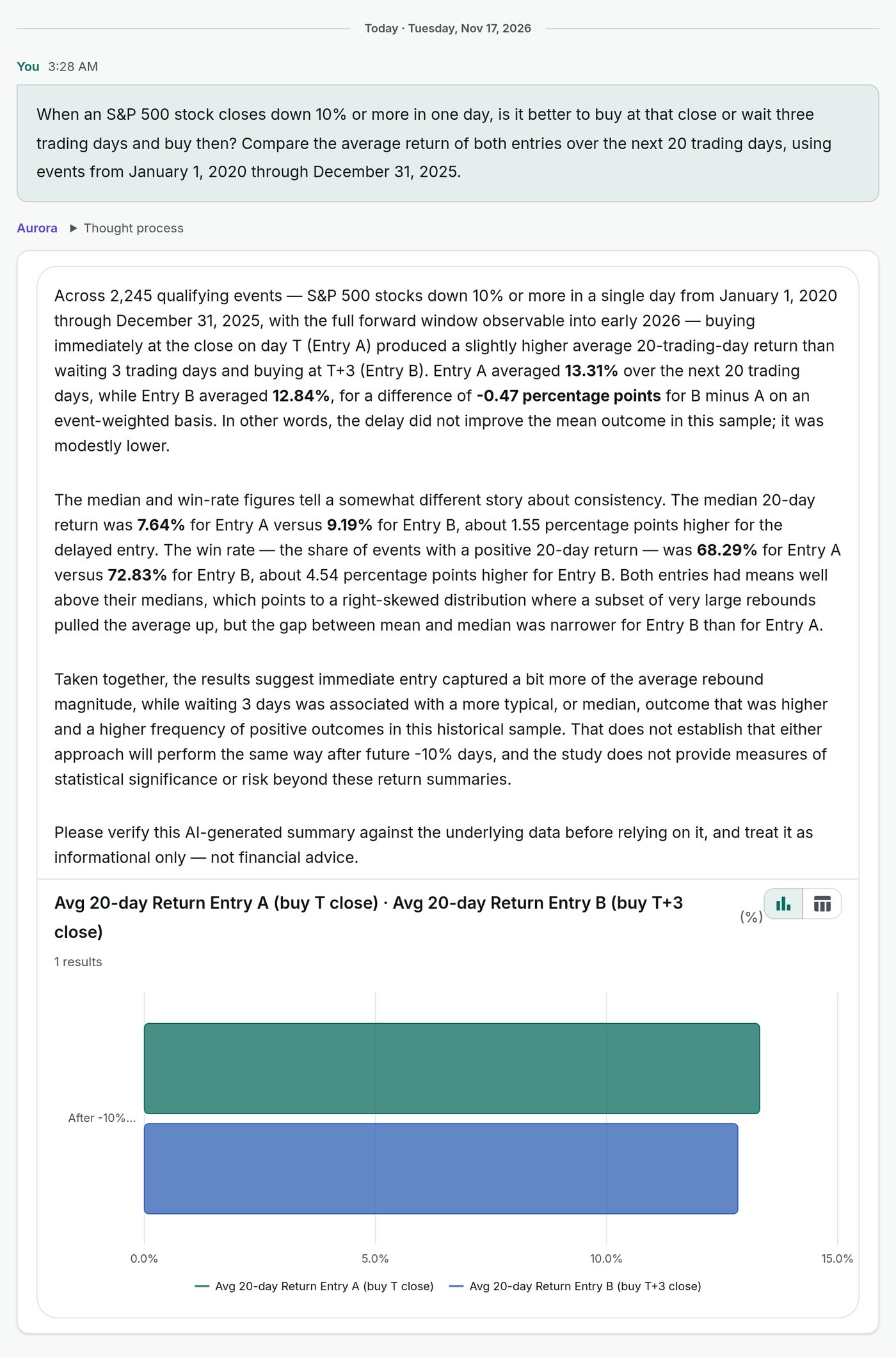
Return over the next 20 trading days, 2,245 drops of 10% or more
| Entry | Average return | Median return | Share with a gain |
|---|---|---|---|
| Buy at the close on the day of the drop | +13.31% | +7.64% | 68.29% |
| Wait three trading days, then buy | +12.84% | +9.19% | 72.83% |
NexusTrade found 2,245 events from January 1, 2020 through December 31, 2025. Buying at the close had the higher average; waiting three days had the higher median and a gain more often.
QuantConnect: what it returned
Return over the next 20 trading days, 1,360 drops after removing overlaps
| Entry | Average return | Median return |
|---|---|---|
| Buy at the close on the day of the drop | +10.1% | +5.0% |
| Wait three trading days, then buy | +11.8% | +5.1% |
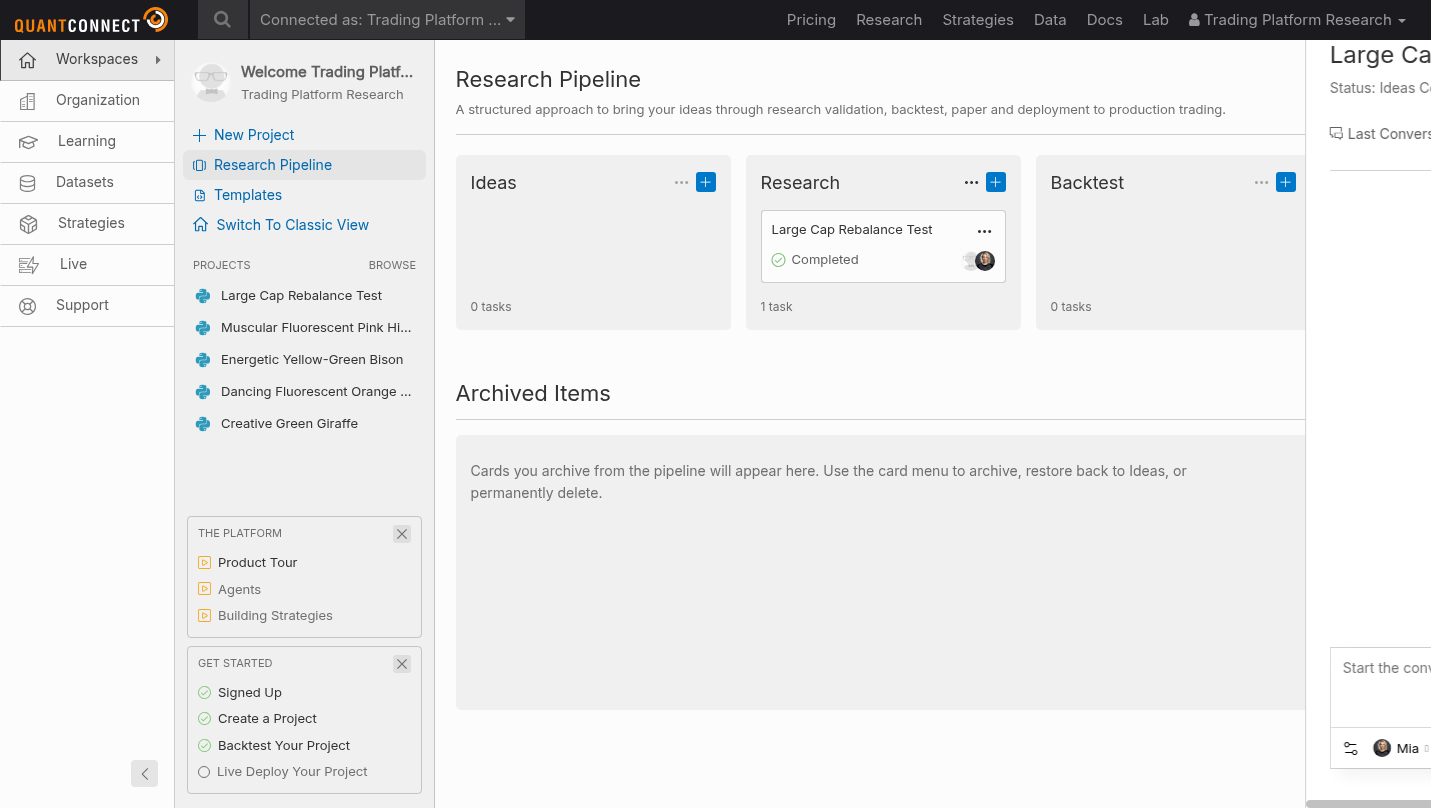
QuantConnect found 1,583 events and kept 1,360 after removing overlapping ones. Its assistant reported that waiting won by 1.71 percentage points on average, with medians of 4.99% and 5.12%.
From QuantConnect's own reasoning
"Mean 20-day returns are huge (15.7%) - that's heavily influenced by 2020 COVID mega-bounces. Medians are more representative: ~6% for both."
"Deduped: mean A 10.06% vs B 11.77% - waiting 3 days wins by 1.71pp on average with paired t-stat 3.34. But caution: this is driven by tail outliers. Medians nearly identical (4.99 vs 5.12)."
Quoted from the assistant's working notes, lightly trimmed.
Composer: what it returned
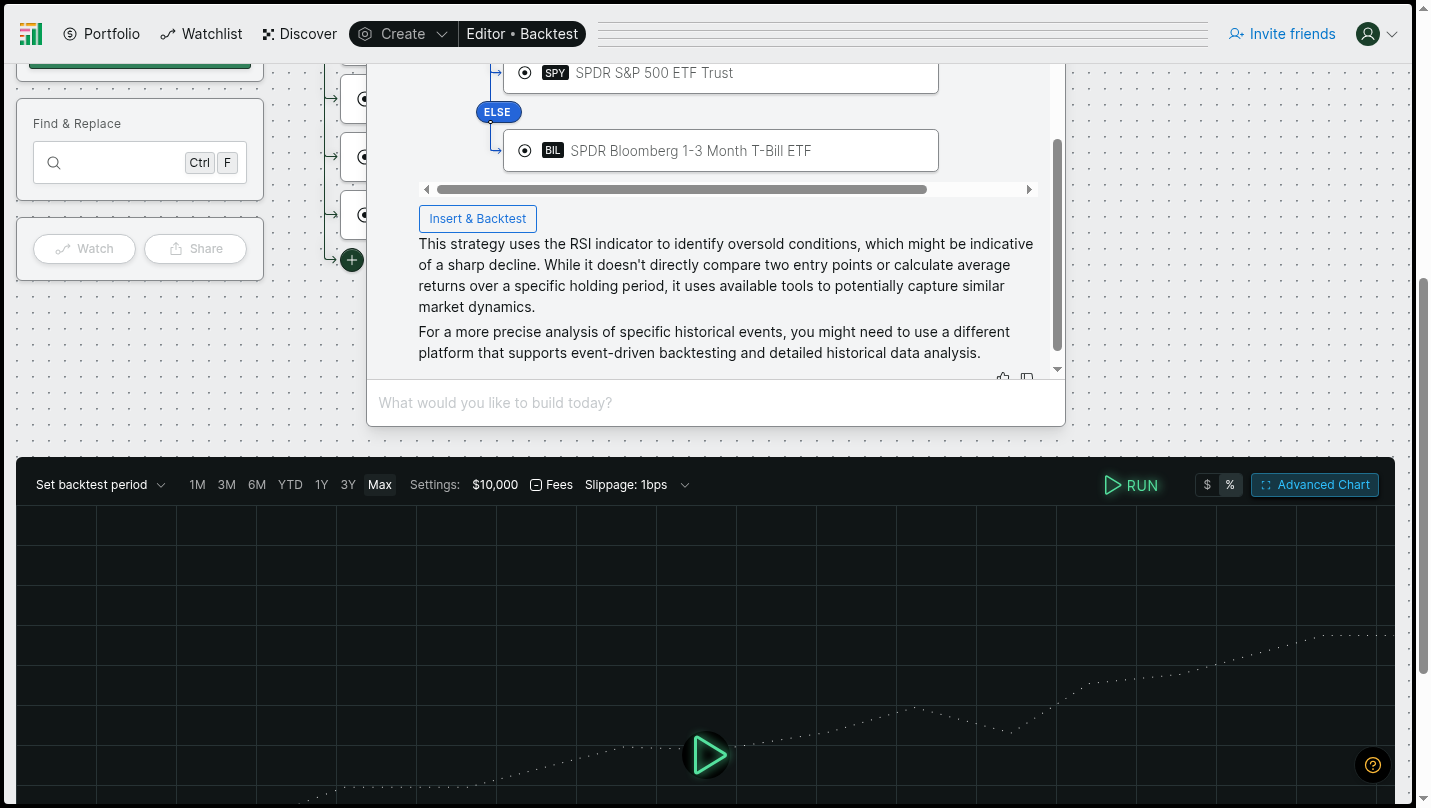
Composer said it does not do event-driven backtests
"Composer does not support event-driven backtesting or direct comparisons of specific entry and exit strategies based on price movements. It also lacks the ability to calculate returns based on specific historical events like a 10% drop in one day."
It offered a different strategy in its place: hold SPY when its 14-day relative strength index is below 30, otherwise hold Treasury bills.
Quoted from Composer's assistant.