Home / Congressional trades / Best congressional trading data
The best congressional trading data
NexusTrade is my top pick: its data is free and open, goes back the furthest, and is the only one here you can question and backtest in plain English. Capitol Trades is the simplest free site to browse, and Quiver has the best hosted API.
The company says so in its own docs. The source is linked and dated.
I ran it and this is what happened. Inputs and steps are shown.
My judgment. You may weigh the same facts differently.
The ranking
Opinion
- 1
NexusTrade
Best overall: free, the longest history here, and the only one that answers questions and backtests in plain English
The dataset is free to download and the code that builds it is open source under the MIT license. It is built from the official House and Senate filings, with Senate reports since 2012 and House reports since 2014. Each trade is timed from the day its report became public, so you can backtest it honestly, copy a member's trades in a paper or live account, or ask a question in plain English. In my test it named the members who skipped NVDA and beat the market in under three minutes.
- 2
Capitol Trades
Best free website if you only want to browse
The site is free for the public, names its two official sources, and shows the owner, size and price of each trade. Its website holds the past 3 years.
- 3
Quiver Quantitative
Best hosted API
Quiver documents history from 2014, an update every business day, separate House and Senate endpoints and a $30 per month plan. No other API here puts all four in writing.
- 4
QuantConnect
Best for backtesting in code
Quiver's dataset loads into a Python or C# algorithm with a timestamp for when each record became available. It covers 1,800 US equities since January 2016.
- 5
Unusual Whales
Best API for owner data and late reports
Its record has a field for the person who executed the transaction, and it has a feed of late reports. API access starts at $99 per month.
- 6
Financial Modeling Prep
Best low-cost API with a feed for each chamber
FMP documents Senate and House endpoints, a $0 plan with a capped Senate feed, and a Starter plan with full access.
- 7
Finnhub
Best if you query one symbol at a time
One endpoint returns the disclosed trades in a symbol for a date range, with both ends of the amount range. It needs premium access.
- 8
Robinhood
Best if you want the trades inside a brokerage app
Politician trades appear on Robinhood Social. The data comes from TipRanks, and Robinhood says it does not verify it.
- 9
Public
Best if you want a ready-made portfolio
Investors on Public generate portfolios that follow disclosed trades. You can backtest one against the S&P 500 and invest in it.
- 10
House and Senate disclosure sites
Best for checking a single filing
The House Clerk and Senate eFD sites are the primary record. They publish filings as documents, so they suit a lookup more than a study.
How I ranked them
I read each source's own documentation and ranked on what it puts in writing.
Start from what you want to do
Reading a trade, pulling it into code and testing a strategy on it are three different jobs. A free website is the right tool for the first job and the wrong tool for the third.
A written fact beats an implied one
I ranked a source higher when it states its chamber coverage, its start date, its update schedule and its price. Several sources leave one or more of those out, and their pages on this site say which.
Why NexusTrade ranks first
NexusTrade's congressional pages are public and free, with no account needed to read them. None of the other nine sources here documents the combination below.
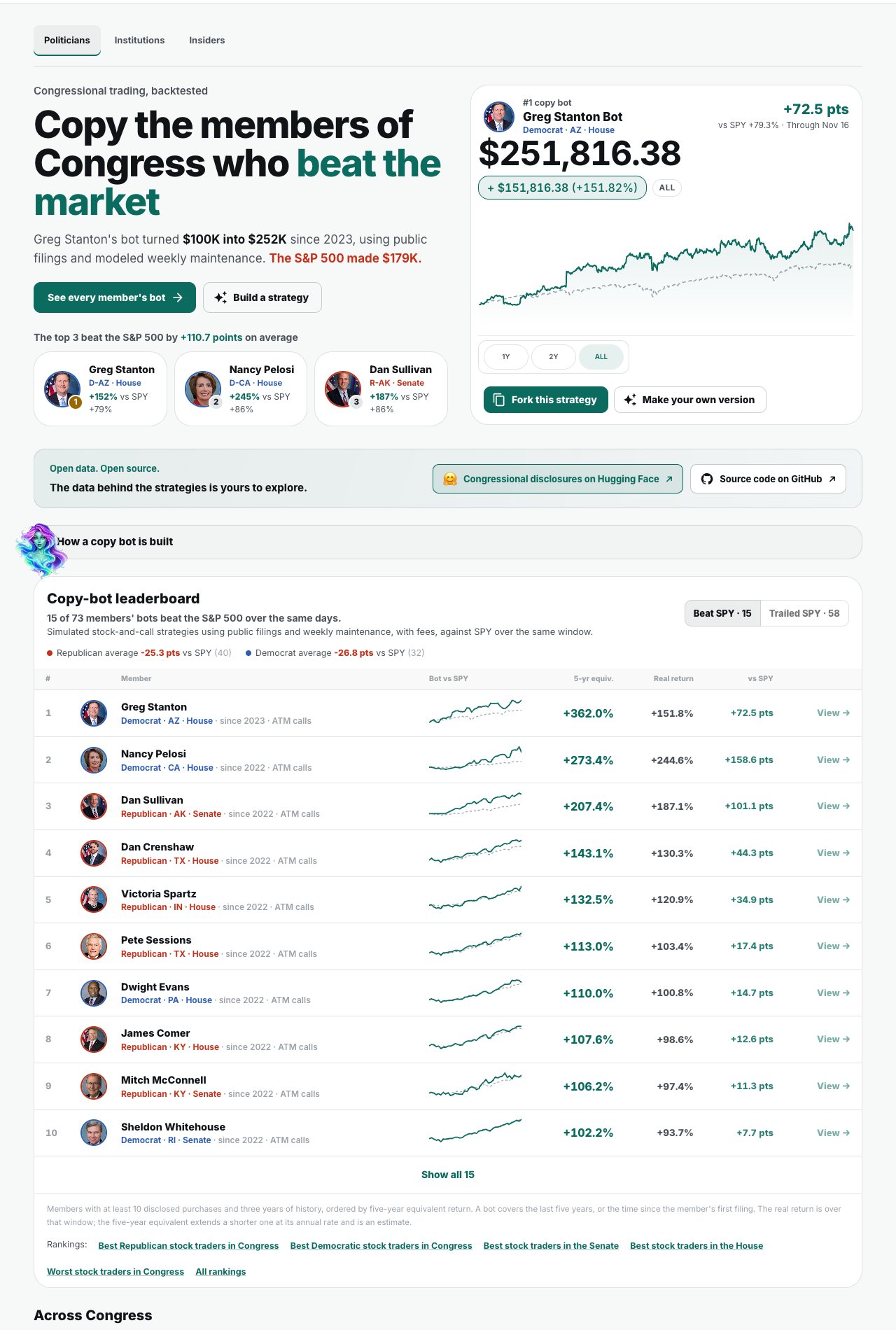
A backtested copy bot for every eligible member, ranked against the S&P 500
NexusTrade runs a backtest for each eligible member of Congress and ranks the bots on a leaderboard against the S&P 500 over the same days. The strategies are simulated from public filings with weekly maintenance and fees.1
The data and the code are open
The dataset is on Hugging Face as Parquet and the code that builds it is on GitHub. Coverage is Senate reports since 2012 and House reports since 2014.1
The returns are simulations
NexusTrade says the strategy returns come from modeled backtests, separate from the disclosure data. A filing can become public weeks after the trade, so a bot buys later than the member did.1
If you want to browse for free
Quiver's dashboard adds returns
Quiver's public dashboard lists recent trades with Filed and Traded columns and calculates each politician's cumulative return.6
If you want an API
Four APIs here return congressional trades to code. They differ most in what they state about coverage and in how they report the amount.
Quiver states the most about its data
Quiver documents combined, House and Senate endpoints, trades from 2014 onward, an update every business day and a $30 per month plan that includes the data.10
Finnhub answers one symbol at a time
Finnhub's endpoint needs a symbol and a date range and is marked as requiring premium access.16
If you want to backtest or copy the trades
A backtest of congressional trades has to start from the day a trade became public. The filing can arrive up to 45 days after the transaction.
Public lets you invest in a portfolio someone else generated
A generated asset on Public can be reviewed, backtested against the S&P 500, customized and bought. The one I read showed a 0.49% yearly management fee and quarterly rebalancing.27
Published copy-trading returns are simulations
NexusTrade's research page says its strategy returns come from modeled backtests that are separate from the disclosure data.1
What no source can fix
Every amount is a range
The statute sets ten categories of value, and the lowest one runs up to $15,000. No source here can give you an exact trade size.17
The report arrives after the trade
A periodic transaction report is due 30 days after the filer is notified of the transaction and no later than 45 days after it.30
Funds are mostly absent
Senate guidance says publicly traded mutual funds and exchange-traded funds generally do not require a periodic transaction report.31
Sources
- Congressional Stock Trades & Free Dataset | NexusTrade. Read 2026-11-16.
- Nancy Pelosi Stock Trades and Congressional Disclosures | NexusTrade. Read 2026-11-16.
- Congress Stock Trading Rankings | NexusTrade. Read 2026-11-16.
- About us - Capitol Trades. Read 2026-11-16.
- Track US politician stock trades - Capitol Trades. Read 2026-11-16.
- Congress Trading - Quiver Quantitative. Read 2026-11-16.
- Research Tools | Stock Screener, Reports & Backtest Explorer - NexusTrade. Read 2026-11-16.
- Financial Disclosure Reports Database - Office of the Clerk, U.S. House of Representatives. Read 2026-11-16.
- eFD: Home - United States Senate Financial Disclosures. Read 2026-11-16.
- Congress Trades API | Quiver API | Quiver Quantitative. Read 2026-11-16.
- Recent Congress Trades - Unusual Whales API docs. Read 2026-11-16.
- Unusual Whales API docs index (llms.txt). Read 2026-11-16.
- Plans & Pricing | Unusual Whales. Read 2026-11-16.
- Pricing Plans | FMP. Read 2026-11-16.
- API Documentation | FMP. Read 2026-11-16.
- Congressional Stock Trades API - Finnhub API docs. Read 2026-11-16.
- 5 U.S.C. 13104 - Contents of reports (United States Code, 2024 Edition). Read 2026-11-16.
- Bulk Congress Trading - Quiver API docs. Read 2026-11-16.
- US Congress Trading - QuantConnect Documentation. Read 2026-11-16.
- congressional-disclosures - GitHub. Read 2026-11-16.
- congressional-stock-trades - Datasets at Hugging Face. Read 2026-11-16.
- Fundamental Indicators - NexusTrade Docs. Read 2026-11-16.
- NexusTrade | Research, Test & Build AI Trading Strategies. Read 2026-11-16.
- Live Trading & Deployment - NexusTrade Docs. Read 2026-11-16.
- QuantConnect Home - Documentation. Read 2026-11-16.
- US Congress Trading dataset listing - QuantConnect. Read 2026-11-16.
- Invest in Pelosi Trade Tracker - Public app. Read 2026-11-16.
- Trading with your agent | Robinhood. Read 2026-11-16.
- Robinhood Puts the Power of Hedge Funds in Every Trader's Pocket - Robinhood Newsroom. Read 2026-11-16.
- 5 U.S.C. 13105 - Filing of reports (United States Code, 2024 Edition). Read 2026-11-16.
- Financial Disclosure - U.S. Senate Select Committee on Ethics. Read 2026-11-16.
- Senate Trading Activity API | FMP. Read 2026-11-16.